

Key takeaways
- Age on its own does not usually rule out a downsize bridging loan, though every lender and case is assessed individually.
- The process can move at a pace that suits you, with time to understand each step before committing.
- Family circumstances and later-life planning can be factored into the conversation from the outset, without it becoming the main focus of the process.
- A downsize bridging loan is not automatic or guaranteed, and the right fit depends on your property, your plans, and your wider circumstances.
- Your home may be repossessed if you do not keep up repayments on your mortgage.
Many retired homeowners considering downsizing their property find that the finance side raises more questions than the move itself.
Will your age count against you? What does the process actually involve, day to day? How does it fit around your family and later-life planning? Can I look to move home at my own pace?
This guide walks through what to expect from a downsize bridging loan as a retired or semi-retired homeowner, from the first conversation through to completion, based on our combined decades of experience in helping clients navigate the process.
Table of Contents
Why do retired homeowners consider a downsize bridging loan?
Although specific reasons naturally vary for each individual, a few themes often come up in conversations with retired clients.
Some want to reduce the upkeep of a larger family home that no longer suits their day-to-day life; others want to release the equity tied up in their current property to support their retirement plans, help family members, or simply enjoy more flexibility; some are moving to be closer to children or grandchildren, and want to secure the right property without the pressure of a rushed sale on their existing home.
But what most of these situations share is a mismatch between substantial property wealth and the income a mainstream mortgage lender would usually want to see.
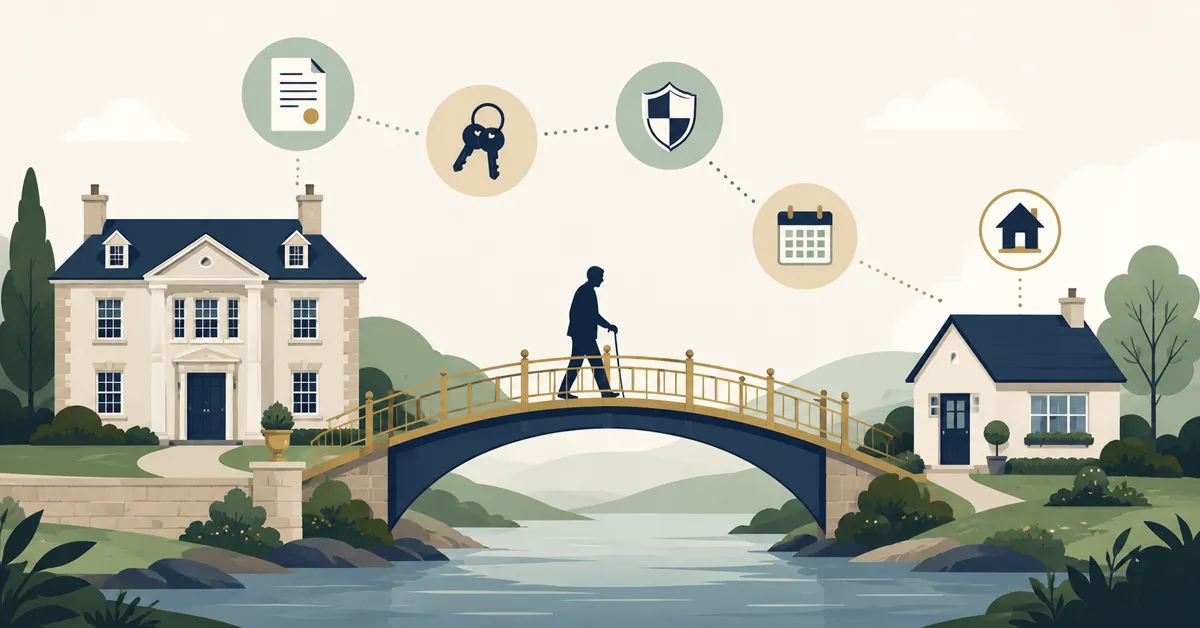
A downsize bridging loan is designed to bridge that gap, allowing you to move into your next home before your current one has sold.
Is there an age limit for a downsize bridging loan?
This is usually one of the first questions retired homeowners ask, often expecting the answer to be a barrier to securing the loan.
But in reality, age on its own does not typically rule out a downsize bridging loan in the way it might for some mainstream mortgage products.
Because bridging is largely asset-based lending, focused on the value of your current property and the one you want to buy, many lenders are comfortable considering applications from homeowners well into later life.
That said, this should never be assumed as guaranteed. Insurer and lender criteria vary, and factors such as the overall exit strategy, the condition of the properties involved, and the specifics of your case will still be taken into account.
If age-related lending criteria are a particular concern for you, this is worth raising directly and early in your first conversation with us, so it can be addressed clearly rather than left as an assumption on either side.
What does the process actually involve, step by step?
Understanding what actually happens, and in what order, is often more reassuring than any amount of detail about lending criteria.
In broad terms, the process usually looks like this:
An initial conversation
This is where you talk through your current property, the home you want to buy, your timescales, and what you are hoping to achieve. It is a great time to ask any questions before anything is set in motion.
Importantly, there is no obligation at this stage.
Assessing your options
Your adviser looks at how the finance might be structured, whether a bridging loan looks suitable for your circumstances, and which lenders may be the best fit.
Identifying a suitable lender
Because every case is different, this step is about matching your situation to a lender likely to be comfortable with it, rather than assuming one size fits all.
Managing the application
From here, the process is supported through to completion, with the aim of keeping things as clear and straightforward as possible at every stage.
Completing on your new home
The bridging loan allows you to complete the purchase of your new property before your current home has sold.
Selling your current property
In a typical case, your existing home is then sold during the bridging term, and the loan is repaid from the proceeds.
For a closer look at how this process works in practice, our guide on how a downsize bridging loan works when you want to buy before you sell may be useful.
A worked example (illustrative only)
A retired homeowner in their late seventies owns a large family home with substantial equity but has a modest pension income. They want to move to a smaller, more manageable property closer to their children, without rushing the sale of their existing home.
After an initial conversation, a downsize bridging loan is arranged based on the value of both properties. They complete on the new home, move in at their own pace, and market their existing property over the following months before it sells and the bridging loan is repaid.
This example is illustrative only and does not describe an actual client of GWD Finance Limited.
How does a downsize bridging loan fit with family and wider later-life planning?
For many retired homeowners, moving home is not purely a financial decision. It often sits alongside wider later-life planning, family conversations, and sometimes estate or inheritance considerations.
It can be helpful to have these conversations with family members early, particularly if they are likely to be involved in supporting you through the move or if the decision connects to wider plans, such as gifting, downsizing to release funds for family members, or preparing for future care needs.
Where legal or estate planning matters are involved, these should be discussed with an appropriate solicitor or financial adviser, since GWD Finance Limited does not provide legal, tax, or estate planning advice.
What should retired homeowners expect in terms of cost and risk?
As with any bridging finance, it is important to go in with realistic expectations about cost and risk, alongside the benefits.
Bridging finance is usually more expensive than a standard residential mortgage, reflecting its short-term, asset-based nature. The loan still needs a realistic exit strategy, most commonly the sale of your current home, and if that sale takes longer than expected, the loan may run for longer than planned.
Because income is not usually the deciding factor in a downsize bridging case, we have covered the detail of how affordability and income are actually assessed in our guide, Does income matter for a downsize bridging loan?, which is worth reading if cost and eligibility are your main concerns.
How does GWD Finance support older homeowners through this process?
Later-life borrowing does not always fit neatly into standard mortgage criteria, and we understand that retired and semi-retired clients often want a different kind of support than a typical high street process offers.
That’s why we take a bespoke, one-to-one approach, taking the time to understand your property, your plans, and your pace, rather than working to a rigid process.
Our experience with older borrowers and more complex cases means we are used to the kinds of questions and concerns that come up specifically in later-life moves. We always aim to provide clear, discreet guidance from your first enquiry through to completion.
Who might a downsize bridging loan not suit?
A downsize bridging loan will not be the right route for every retired homeowner.
It may be less suitable if you:
- Need a long-term borrowing solution rather than short-term finance
- Do not have a realistic plan or timeframe for selling your current property
- Would be uncomfortable with the higher costs typically associated with bridging finance
- Are not yet ready to commit to a move and want more time before starting the process
- May be better served by a standard mortgage, equity release, or another funding route better suited to your circumstances
- Have significant concerns about the process that have not yet been discussed with an adviser
This is not an exhaustive list, and your own circumstances should always be assessed individually before deciding on any course of action.
Key questions to ask before you start
- What is my realistic timeframe for selling my current property?
- Have I discussed my plans with family members who may be involved or affected?
- What level of equity do I have, and how does that compare with the cost of my new property?
- Am I comfortable with the pace and structure of the process, or do I need more time to consider it?
- Have I asked directly about how my age and circumstances will be assessed?
- Do I need to speak to a solicitor or financial adviser about estate or later-life planning alongside this move?
FAQs about downsize bridging loans for retired homeowners
Is there an upper age limit for a downsize bridging loan?
Not necessarily. Because bridging is largely asset-based lending, many lenders will consider applications from older homeowners, though this depends on the lender and the specifics of your case. It should never be assumed as guaranteed.
Can I get a downsize bridging loan if my only income is a pension?
Potentially, yes. In many downsize cases, the lender focuses primarily on the value of your current and new properties rather than income in the way a standard mortgage would. Our guide on does income matter for a downsize bridging loan? covers this in more detail.
What happens if I need to move into care during the loan term?
This will depend on your individual circumstances and the terms of your loan. If this is a realistic possibility for you, it is important to raise it early so it can be discussed openly as part of planning your exit strategy.
Can a family member support or guarantee the loan?
This will depend on the lender and how the case is structured. If family involvement is something you are considering, this is worth raising directly in your initial conversation.
How long does the process usually take from enquiry to moving in?
Timescales vary depending on the lender, the properties involved, and how straightforward the case is. One advantage of bridging finance is that it can often move more quickly than a mainstream mortgage, but every case should be assessed individually.
Can GWD Finance Limited advise on legal or tax matters?
No. GWD Finance Limited can advise on downsize bridging loans and related property finance planning, but does not provide legal or tax advice. Where legal agreements, estate planning, or tax treatment need to be considered, you should speak to an appropriate solicitor, accountant, or tax adviser.
Conclusion: it’s a process that can move at your pace
There is no single answer to what every retired homeowner should expect from a downsize bridging loan – it depends on your property, your family circumstances, and what you want the move to achieve.
What matters most is having a clear, honest conversation with an experienced adviser early on, so you know what to expect at every stage.
Talk through your downsize bridging loan options confidentially
If you are a retired or semi-retired homeowner considering a move and want to understand whether a downsize bridging loan could work for your circumstances, GWD Finance Limited can help you talk it through clearly, discreetly, and with advice tailored to you.
For a no-obligation, confidential chat, you can:
- Call 020 7971 1416
- Email info@gwdfinance.com
- Complete the contact form below
Your home may be repossessed if you do not keep up repayments on your mortgage. The information contained within was correct at the time of publication but is subject to change and does not constitute as advice.
